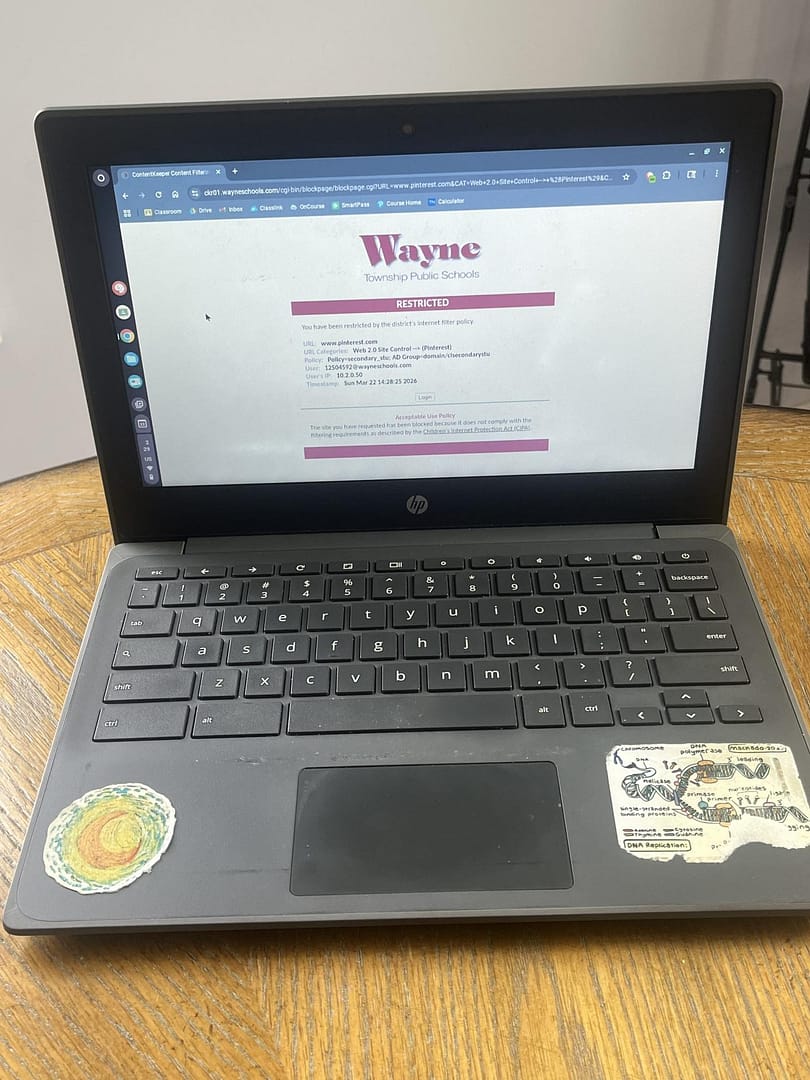
Bored in class? Have you ever tried to open one of those games on your school Chromebook only to get, “This website has been blocked”? Seems reasonable. Now imagine you’re trying to do work for a class until this website is blocked too. Seems weird, doesn’t it?
Web filtering is often used in schools to ensure the online safety of all students. The internet can be filled with educational resources, but also inappropriate content. While the intent is to protect, overly restrictive web filtering can limit essential websites, resources, and tools that can affect learning and teaching.
“I find it annoying when my teacher assigns us a website to use, and it’s blocked,” tells Wayne Valley sophomore Arianna Cisneros, “if my teacher gave it to us for learning purposes, there’s no reason it should be restricted.”
Certain amounts of web filtering are often helpful in blocking students from graphic images, cyberbullying, distracting entertainment websites, and online predators. Especially for younger students on the internet, a restricted web can ensure safety and protect them from any unjust exposure.
Many web filtering networks do not block specific websites but enter certain keywords to restrict. This can prevent students from learning how to navigate the internet responsibly and make decisions. A crucial part of student development relies on the ability to evaluate different types of information. Heavy filtering discourages students from learning which resources they can trust to be accurate or safe.
“I do think there should be some filters on our browsers because we have students who are minors,” says Wayne Valley English and Journalism teacher Mrs. Nazarko. “However, I feel that the ones we have on are too restrictive for everyday websites. I do not understand why many sites are blocked, but others are not, [such as] certain historical sites [that] have been blocked. We need to fix the algorithm and some of the filter words,” she adds.
As well, overly restrictive web filtering can be a form of censorship. They can limit access to academic websites. Some topics, such as those for a health class, often get blocked because they are deemed inappropriate or controversial, when they often include educational details. Legitimate school websites are often blocked due to web filtering, while they pose no legitimate threat to students.
This does not mean that schools should remove their web filtering entirely. The Children’s Internet Protection Act (CIPA), passed by Congress in 2000, requires schools and libraries to restrict, monitor, and enforce safe policies on the internet for them to become eligible for the E-Rate discount program. This program makes certain technology and communication programs more affordable for those eligible.
However, some changes can be made to the system of web filtering in schools. Schools can adjust content controls for different age groups. As students mature, they should be allowed access to more information. In addition, schools can provide teachers with the ability to approve websites. They are the ones who know best what resources are needed to ensure a child’s success.
Web filtering protects students from anything that may be considered unsuitable for their age group. Especially in schools, a form of this is needed for students, as many of them are minors, and the internet can be an unsafe place. The question that needs to be asked in our schools is: when do these restrictions begin to affect the ability of students to learn and teachers to teach?