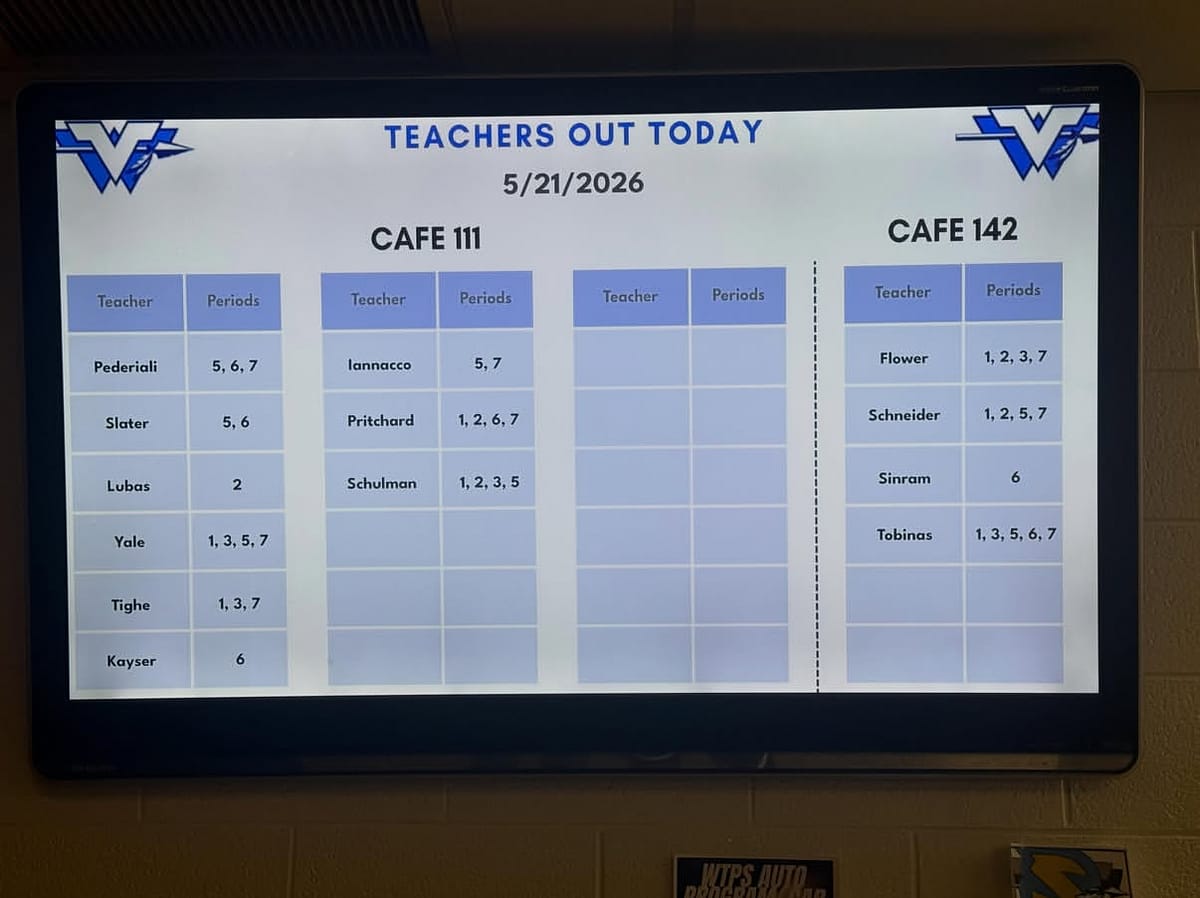
When students arrive at school, they no longer have to wait for class to see which one of their teachers isn’t present. Instead, an “absence board” is displayed around the school, indicating which cafeteria students should arrive at.
The new procedure was implemented midway through the 2024-25 school year, making the 2025-26 school year the first with “no subs.” The cafeterias are often monitored by 2-3 substitutes rather than 1 per class.
For most classes, the switch is no problem. Many of the core classes here at Wayne Valley, such as English, Sciences, Math, History, and Languages, can complete the same worksheet or assignment they would have in the classroom with a substitute. However, elective classes, such as TV, Photography, Foods, Wood Shop, and many others, require the use of classroom equipment for learning.
Wayne Valley’s TV Teacher, Mrs. Damer, shares, “When I am absent, it is difficult for me to give assignments that align with the curriculum. The majority of what we do in TV involves using studio equipment, like the cameras and editing software. Obviously, the students don’t have access to any of these things when corralled into the cafeteria.”
This can throw the class off track for the day, slowing them down if they are working to complete an assignment swiftly. Assignments in the cafeteria become redundant when the class is entirely focused on a different kind of learning.
“When we are in the cafeteria for photo [photography class], we often get assignments that don’t always relate to the class because we are very restricted and can’t actually get up and take photos as we would during a normal class period,” says Wayne Valley Sophomore Gracie Turro.
Many classes are not confined to paper or a Chromebook, but rather hands-on equipment that is inaccessible in the cafeterias. There are no cameras, sewing machines, or wood-cutting machines in the cafeteria. What could have been a productive day in class turns into an academic study where students cannot work on anything intended for these electives.
Students and teachers of these classes are put at a disadvantage when it comes to a cafeteria academic study hall in lieu of a teacher’s absence. Classwork that can be worked on with or without teacher presence cannot be done for these classes without the correct classroom environment. This “solution” may work for some classes, but for others, it makes work that is correlated to the curriculum impossible to complete.