
Today, more and more schools are reverting from test-optional to test-required. However, even when submitting to a test-optional school, students constantly wonder whether submitting their scores may hurt or help their chances of admission. Is test-optional really optional? Additionally, many students wonder which test to take: the SAT or the ACT? What even is the difference between the two? Are either of them really a fair standard of measuring a student’s academic caliber? How many times should a person take either test before moving on, and what is considered a good score? How early should a student start to prepare, and how much preparation is enough? Is it worth it to even take the SAT or ACT? This article will cover all these questions and even add some advice.
To start off, Big Future, the site developed by College Board to help students navigate the application process, details the differences between the SAT and the ACT.
Practice Available
The SAT offers many free official practice resources. There are 7 free practice tests on Bluebook, the platform where students take the actual SAT. College Board has also partnered with Khan Academy and Schoolhouse. On Schoolhouse, students are provided with a tutor who has taken the SAT themselves and has gotten above a 700 on the section they are teaching. Students can also access the Question Bank on College Board, which has questions from previous SATS that are ranked by topic and level of difficulty.
ACT practice is mainly on different platforms than what students test with. There is only 1 free downloadable practice test, and 2 online. The ACT is partnered with other sites, but you have to pay for this prep, and it can cost up to $4,140 for some programs.
Familiarity
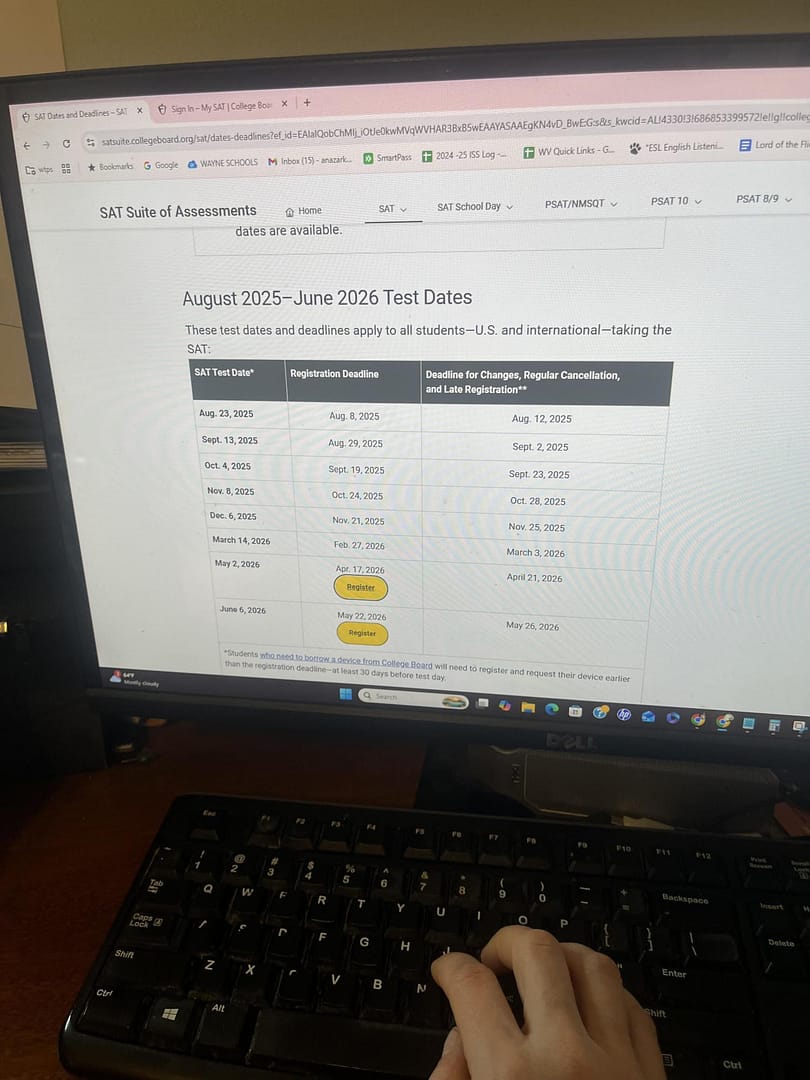
The format of the SAT is more familiar, at least to students at Wayne Valley, as we are given PSATs (preliminary SATs) in our sophomore and junior years. Additionally, the format of the SAT is the same (1 reading section and 1 math section, both split into two modules of ranging difficulty), no matter where or when you take it, and you choose the device on which to take the test. For availability, most schools offer the SAT exam consistently every month that the exam is available to students.
The ACT can change depending on when and where you take it. In most places, you do have to take notes with paper and pencil, and if the digital option is available, you will be assigned a device you are unfamiliar with. Moreover, your local school district may not proctor the ACT exam, and its monthly availability may fluctuate because of several factors.
Length
The SAT (at 2 hours and 14 minutes) is shorter than the ACT and has more time per question. It also has shorter reading passages, and each passage has one question associated with it. There are a total of 54 questions for the English section and 44 total questions for the Math section.
The ACT passages are always long, and there are 9 questions on each passage. There is also an extra section on the ACT, the science section, which the SAT does not have. In 2025, it is not required for students to take the science section, but some colleges do prefer it. The ACT generally takes up to 2 hours and 5 minutes, with Math, English, and Reading sections. However, with the addition of the optional Science and Writing sections, the total testing time increases to approximately 3 hours and 25 minutes.
College Preference
The good news: colleges don’t care which test you take; they weigh both the SAT and the ACT the same. The one thing to consider again may be the sectioning and scoring on the ACT. Some colleges are changing their policy on whether the science section is required and if superscoring (averaging section scores across multiple attempts) is accepted.
In the end, though, the choice of which test to take is completely up to you. Different students do better on different tests. The official ACT site acknowledges this and explains that the ACT exam tests students on an understanding of their high school curriculum, while the SAT is more of an aptitude exam. One piece of advice to consider: take both a practice SAT and a practice ACT. As you’re taking them, note the differences and which one you prefer; then, compare your scores.
An important tool to consider when deciding whether or not to submit your score is your top college’s median SAT and ACT score ranges. The score ranges, which can often be found with a quick Google search, show the scores of the middle 50% of students who were accepted. For example, as found on Brown University’s official website, their median ACT is between a 34 and a 35 (with the highest possible score being a 36), and their median SAT is between a 1480 and a 1560 (with the highest score being a 1600). If you are in or above this range, submitting your score may be beneficial. The median range can also help you figure out your goal score and how much you need to practice to reach it.
The SAT and ACT are both tests that measure your readiness for college and help colleges compare students from different high schools and backgrounds. However, the question has been raised whether tests like these are truly a good measure of academic success. One of the main concerns in this area is money. If a student who is better off financially does not do as well on their first attempt, they can buy sessions at various tutoring and prep courses. A student who is not as well off financially cannot always afford the same amount and type of prep. However, CollegeBoard has tried to combat this with its partnerships and free online practice. Another concern is test-taking stress. Many people find taking tests daunting, especially one that may greatly influence which college they end up going to in the future. This can cause them to underperform. However, in many college applications, there is an additional information section where students can share factors like this that may affect their application.
The main thing to remember for these standardized test scores is that they are not the deciding factor in determining college admission or success. Admissions look at many other factors, such as essays, grades, and extracurricular activities. Also, a high SAT or ACT score does not automatically grant admission. In the same way, a high or low score does not determine if you do well or poorly in college.